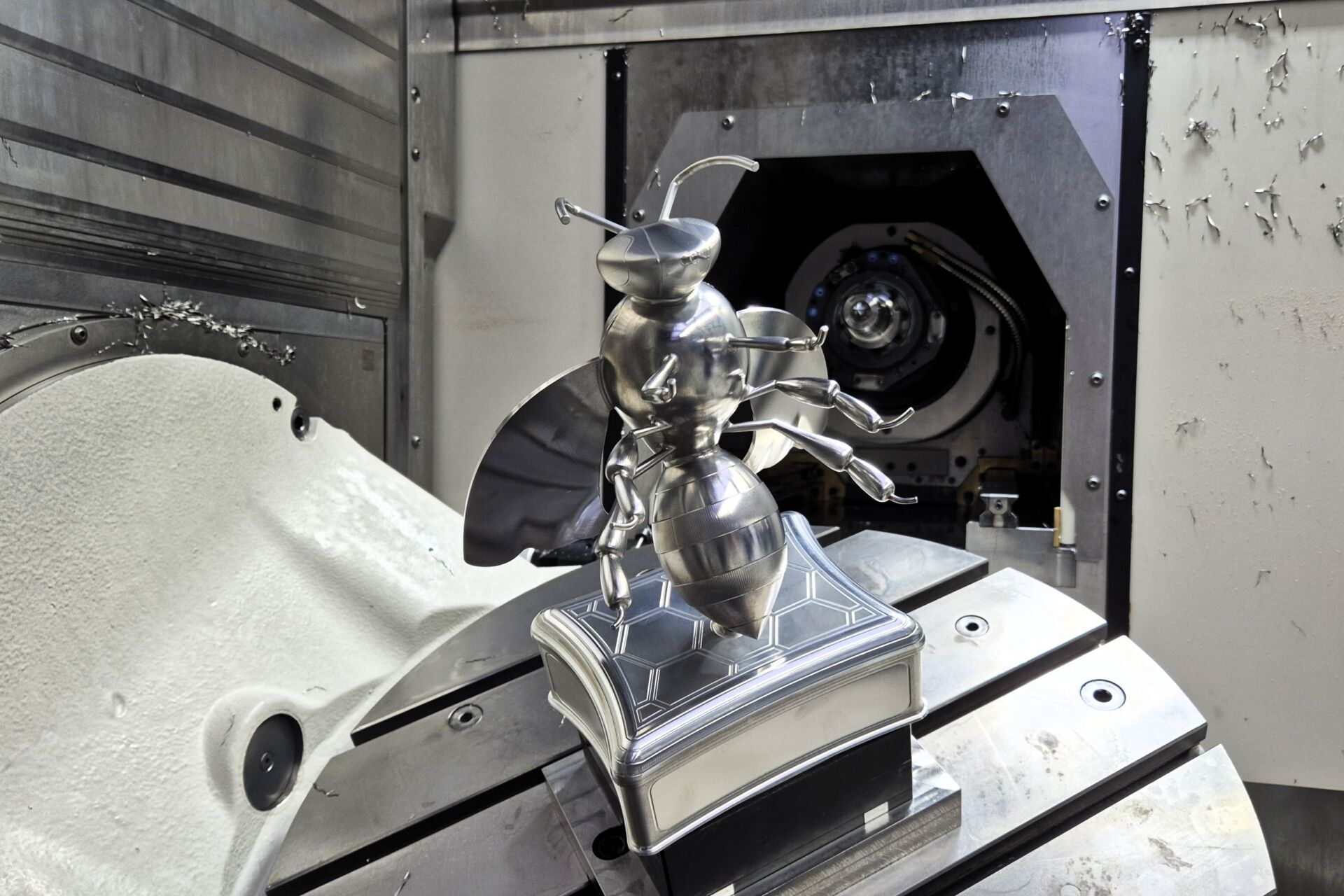
A new demonstration project at the Ceratizit Technical Center in Rosendaal, The Netherlands brings together the expertise of four technology partners in an inspiring showcase. Metalworking fluids, cutting tools, machine engineering and CAD/CAM software were combined into a true technical masterpiece: a 20-centimeter aluminum honeybee featuring complex contours, delicate structures and highly detailed surfaces. Together, Ceratizit, Grob, Open Mind and Telko realised Project Beehive: a striking example of precision, innovation and collaboration. The result is not only an impressive demonstration of five-axis machining, but also a symbol of what becomes possible when knowledge, technology and craftsmanship are perfectly aligned, just like in a beehive.
The choice of a honeybee is no coincidence. The insect symbolises cooperation and dedication: values that lie at the heart of the manufacturing industry. Tinus Zuetenhorst, Managing Director of Ceratizit Netherlands, explains:
“Our Technical Center has always focused on realising projects together with partners that inspire customers and bring knowledge together. Project Beehive perfectly illustrates how collaboration between specialists leads to results that would not be achievable individually. With a workpiece this complex, cooperation is literally the key to success.”

Design and Digital Preparation
The design of the honeybee followed a remarkable development process. Kain Borst of Open Mind worked intermittently on the 3D model over a period of five years. “It started as a personal project, but the technical complexity made realisation difficult,” Borst explains. “Thanks to the collaboration with Ceratizit, Grob and Telko, we were finally able to bring the design to life.”
Digital preparation was carried out in HyperMill, where machining strategies were simulated and optimised. Fragile elements such as antennae, legs and wings required intelligent strategies to maintain structural rigidity for as long as possible. Only after sufficient supporting material had been removed were the fine finishing operations performed. The programming focused on optimal tool loading, minimising heat input and preventing vibrations.
The five-axis interpolation of the GROB G350 ensures smooth transitions and consistent cutting conditions. For the thin elements, the emphasis was on minimal cutting forces to prevent deformation. Curved surfaces were machined using ball-nose end mills with a small stepover to achieve a uniform surface finish. By varying the milling paths, the bee’s body was given a subtle, natural texture; creating a perfect balance between engineering and aesthetics.
72 Hours of Craftsmanship and Precision
Producing the honeybee required approximately 72 hours of machining time. The original aluminum block weighed 32 kg; the finished component weighs just 6 kg. This ratio alone highlights the level of precision involved. The finest details, such as legs and antennae with diameters of only 3 to 5 mm, demanded specialised machining strategies, fixturing solutions and tool selections.
For this project, GROB provided a five-axis G350 machining center at the Technical Center. Iggy Rolando of Grob explains that he was immediately drawn to the vision behind the project: “This is all about knowledge sharing and collaboration. The G350 is ideal for projects like this because it combines maximum precision with high dynamics. The aluminum honeybee is a perfect example.” The machine played a crucial role in the process. Thanks to the rotary-tilting table and horizontal spindle, the workpiece could be optimally positioned, allowing the tool to reach even the most difficult-to-access areas. Michael Falk of CERATIZIT adds: “The kinematics of the GROB G350 make it possible to select approach angles that limit the required tool length while improving coolant delivery and chip evacuation. This is critical when machining unstable structures such as the honeybee’s legs and antennae.”
High-End Aluminum Milling
Machining aluminum at this level required a carefully selected combination of cutting tools and metalworking fluids. Ceratizit supplied eighteen different milling cutters across 28 tool positions, each designed with optimized cutting geometries and controlled chip evacuation. The result: maximum process reliability, minimal heat input and outstanding surface quality.
The tools used, including ball-nose end mills with small radii and light-cutting CCR end mills, feature substrates, geometries and coatings specifically developed for aluminum machining. Although aluminum is generally considered easy to machine, it is prone to chip adhesion and built-up edges. To prevent this, the chip flutes are extremely smoothly polished and coated with a non-stick layer. Aluminum milling cutters also have fewer teeth than steel cutters, further improving chip evacuation.
Liquid tooling
Telko, formerly Optimol Lubrication and a Castrol distributor since 1958, supplied the metalworking fluid, aptly described as “liquid tooling.” Leon Verschuren of Telko explains: “In machining, there are only two elements that come into direct contact with the workpiece: the cutting tool and the metalworking fluid. Choosing the right emulsion is therefore crucial for process stability, dimensional accuracy and surface quality. That’s why we refer to our emulsions as liquid tools, they have a decisive influence on both the process and the final product.”
Metalworking fluids such as Castrol Hysol SL 50 XBB, used in this project, play a key role in machining: they provide lubrication, reduce frictional heat and ensure efficient chip removal. This is especially important when machining aluminum, which expands more than steel. Effective heat dissipation prevents dimensional deviations, improves surface quality and extends both tool life and overall process stability.
Choosing the right emulsion is crucial for process stability, dimensional accuracy and surface quality.
The GROB G350 machine itself was also equipped with high-quality Castrol lubricants to ensure a stable and reliable production process. Castrol MAGNA SW D 68 slideway oil provides optimal guidance and wear protection, while Castrol Hyspin AWH-M 46 hydraulic oil ensures stable operation of the hydraulic system, even under high loads and temperatures.
Presentation at TechniShow
The five-axis machined aluminum honeybee will be presented from 10 to 13 March 2026 at TechniShow in Utrecht, The Netherlands. At the stand of Telko, the final result and all technologies used will be demonstrated in collaboration with the other project partners. Visitors will be able to see Telko’s metalworking fluids, Ceratizit's cutting tools, Open Mind’s HyperMill software and the Grob G350 machining center in live operation.